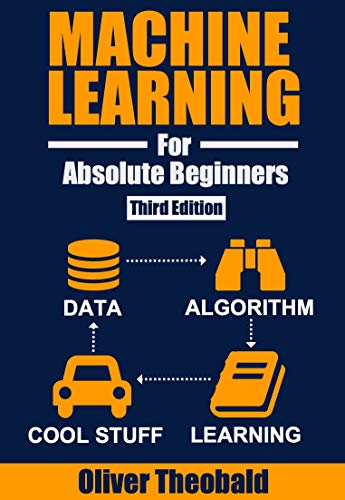
Machine Learning for Absolute Beginners: A Plain English Introduction (Third Edition) (Learn Machine Learning for Beginners Book 1)
*Machine Learning for Absolute Beginners* serves as a foundational guide for individuals with no prior experience in data science or programming. Recommended by Tableau as a top resource for novices, the book prioritizes high-level theory and statistical principles over complex coding exercises. It offers plain-English explanations and visual examples to demystify core algorithms, making it an accessible alternative to dense, expensive textbooks. While the primary focus remains on conceptual understanding, this updated Third Edition introduces readers to Python coding through specific chapters and supplementary online video tutorials, bridging the gap between theory and practical application. The content covers essential steps in the machine learning pipeline, starting with acquiring free datasets and selecting appropriate libraries. Readers learn critical data preparation techniques such as scrubbing, one-hot encoding, binning, and handling missing values. The book also details key analytical methods, including regression analysis for trend lines, k-means clustering for discovering relationships, and decision trees for classification. Furthermore, it explores fundamental concepts like neural networks, bias/variance trade-offs, and k-fold validation to ensure robust model performance. Designed specifically for true beginners rather than intermediate practitioners, this guide acts as a gentle introduction to the field. It does not aim to create experts immediately but rather provides a clear overview of the landscape, preparing readers for more advanced study. By the end of the book, users will have the knowledge to build a preliminary prediction model, such as forecasting house values, using Python. This edition includes quizzes and downloadable resources to reinforce learning, ensuring a comprehensive starting point for anyone looking to enter the world of artificial intelligence and machine learning.
About the Authors
Oliver Theobald